
Designed by LEVORA
The product architecture, campaign flow, commercial criteria and user experience were defined by LEVORA.
Prospecting and sales intelligence platform conceived and developed by LEVORA. Scout searches, organizes and analyzes public context to help sales teams understand where to act first — with artificial intelligence, custom criteria and human decision-making.
LEVORA Scout was born inside LEVORA itself, from a real problem: too much time spent searching for companies and too little clarity about which ones could represent a concrete opportunity.
Instead of adding yet another database to the sales process, LEVORA designed a system that connects research, interpretation, scoring and follow-up. Each campaign starts from the market, location and criteria defined by the company. The result is an opportunity base prepared to compare, prioritize and approach with more context.
Scout did not begin as a theoretical product or as an artificial intelligence layer applied to a directory.
It was born from the need to make prospecting more rigorous: researching companies, quickly understanding their context, identifying opportunity signals and maintaining a workflow that did not depend on dozens of tabs, spreadsheets and scattered notes.
The product architecture, campaign flow, commercial criteria and user experience were defined by LEVORA.
It is not third-party software with a new visual identity. It is proprietary technology, created to evolve and adapt to different sales operations.
The product was designed around the work that happens before a sale: defining the target, researching, interpreting, choosing priorities and tracking contact.
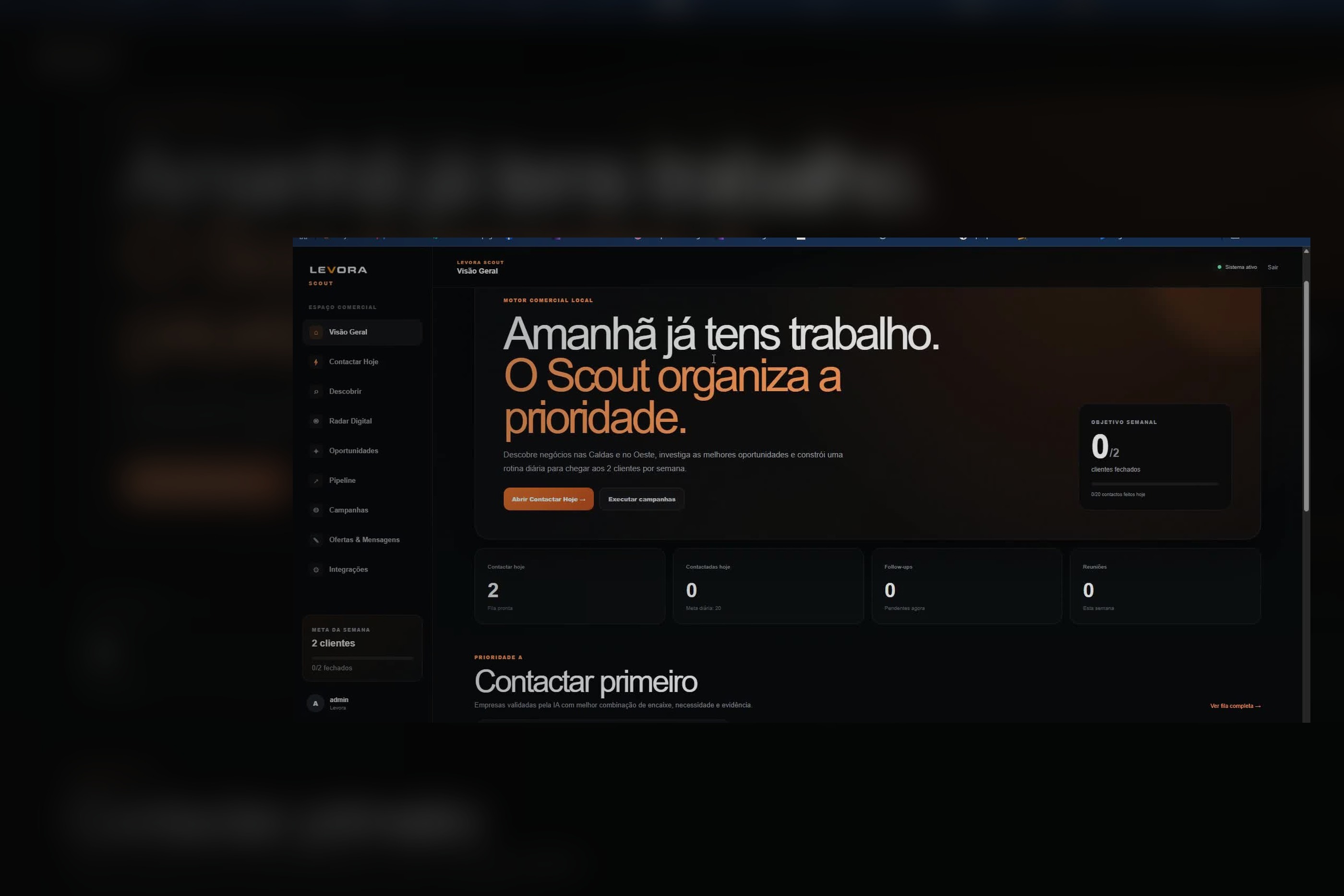
A brief demonstration of the real flow: market definition, research, opportunity reading and sales contact preparation.
Product demonstration. The result of each campaign depends on the market, the criteria used and the public information available.
Scout combines assisted research, language models, LEVORA's own rules and criteria defined by the company.
Artificial intelligence acts between company discovery and the commercial reading of that opportunity. It interprets public information, organizes scattered signals and produces an explainable analysis. The scoring is not a sales promise: it is an indication of priority based on the available context.
The system reads the sector, location, keywords, customer profile and commercial objective. These elements form the framework used throughout the analysis.
Scout searches for companies and publicly available information on websites, search engines, directories, maps, news and other sources relevant to the campaign.
Names, locations, websites, institutional contacts, activity and digital signals are organized in a coherent format. Duplicate or incomplete records can be identified and handled.
The AI relates what it found to the campaign criteria: sector fit, geographic presence, digital maturity, apparent needs and other indicators defined for the project.
Each opportunity receives a reading and a score. The team can understand the factors that contributed to that priority, instead of receiving only a number without context.
Scout brings together the essential elements for outreach, helps prepare the contact and maintains opportunity status. The final message and the decision to move forward remain with the team.
Scout works with public information and data entered by the company. It does not access private information, does not guarantee that an opportunity will become a customer and does not replace human validation. The quality of the analysis depends on the campaign criteria and the information available in each market.
Organize campaigns by sector, territory and custom terms, without starting from a generic database unrelated to the market.
Gather context on each company and concentrate the commercial reading in a single record, instead of scattering research across multiple tools.
Compare opportunities, identify relevant signals and establish a contact order consistent with the campaign objectives.
Scout supports work before, during and after the first contact. The platform organizes the information; the decision remains with the team.
Market, location, search terms and commercial objective.
Companies, digital presence, public contacts and useful signals for evaluation.
An organized reading to understand where there is greater alignment with the campaign.
Contact logging, opportunity status and continuity of the commercial work.
It is not a purchased list. It is not an automatic decision. It is intelligence applied to a sales process.
Scout was developed to expand the team's analytical capacity, not to replace commercial judgment. The technology organizes and interprets; people validate, decide and build the relationship.
Understand the contextB2B companies developing new markets or territories.
Sales teams that need context before outreach.
Managers who want to track priorities and opportunity progress.
Organizations still working with research, spreadsheets and scattered information.
Tell us the sector, region and type of opportunity you are looking for. We will prepare a conversation focused on your company's real context.
Request demo